Is your yoga more like a cupcake or a muffin?

appearance-muffin-vs-cupcake


Some say cupcakes are just muffins that believe in miracles.  Today we explore that age-old question -what is the difference between a cupcake and a muffin?  We eat them and seem to believe intuitively and clearly that there is a difference but what is this difference really?


The answer is subtle.  Muffins are more “bread like” while cupcakes are more, well, “cake like”.  Muffins seem to us to be healthier to eat, not filled with sugar, but rather filled with ingredients good for us like- oats, bran, or fruit.


Cupcakes are loaded with extra sugar, and topped with frostings. They usually come at an end of a mealtime as a desert – adding a flourish to the ending of the meal. They seem sweet on the way down but somehow leave you with a sense of absence after the initial sugar high wears off.


To a baker, muffins are made more like how a loaf of bread would be made, while cupcakes usually are made closer to how you would make a cake.


What is your approach to your yoga practice?   When you go through your asana practice, are you more like a cupcake or a muffin? Are you digging down deep inside, making sure all the parts of the pose are integrated together, experiencing the pose from the bottoms of your feet, to the top of your body and letting the poses kneed into your inner being and the core of who you are?  Or are you just looking for the quick fix, the sugar high, and the “I did some yoga today” check box before setting off on another activity?


What’s the difference between expressing a yoga pose completely and just going through the motions?   It’s similar to eating the healthier muffin or the more sugary cupcake.


The poses may look similar on the outside but on the inside the core ingredients are different.  Your approach to the pose is different, your body feels subtly different and when you practice your energy is different.


Ask yourself, are you approaching youryoga practice with a lot of sugar and sweetness or are you doing a healthier more fulfilling version? For each pose, are you expressing yourself to your fullest potential or are you just doing it not believing it is important how you express yourself and just moving on to the next pose.  Start doing your yoga practice, as a muffin would, full of good ingredients but also with just a bit of sweetness and filling as well.


Feel all the complexities in the flavor of the pose.  Believe in yourself, knowing you have done the pose to the best of your ability. Become the muffin.


lolly licking

Sit, Settle, and Sigh – the three S’s and relieving stress

Yoga Sitting Sit Relax Meditation Qigong


We all have stress. Want a quick way to reset your stress level?  Try this.  Find a comfortable, preferably quiet place where you can sit for a few moments.  Sit comfortably in any way that feels good for you.  You can sit cross-legged on the floor, carpet or in a chair.  Take a few moments to settle the body.  Notice any tensions that come into you as you sit with yourself for a few moments.  Try to release the tensions by slightly moving, and settling yourself down until you can remain comfortable.

Sigh.

Start audibly, taking a breath into the body and releasing the breath by sighing through the mouth.  (You probably want to be alone for this).  If you can try closing the mouth and create a sigh just by using your the nose.  Try this for a few minutes.  Then sit quietly,  and notice your state of mind.  Just a few minutes a day can help you reset the stress you may be feeling!

Sound Meditation

soundmeditationbowl


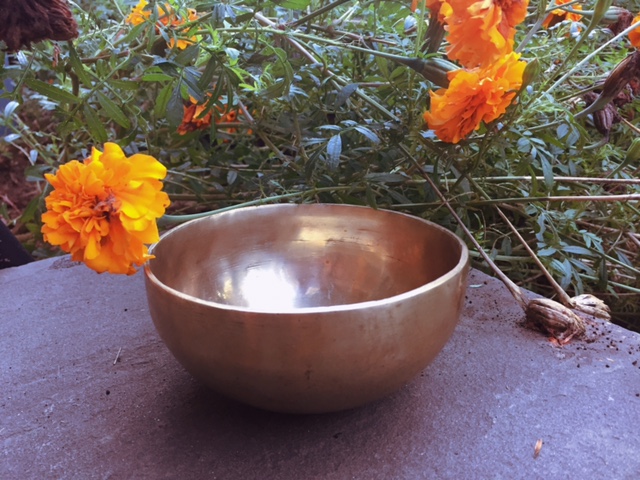
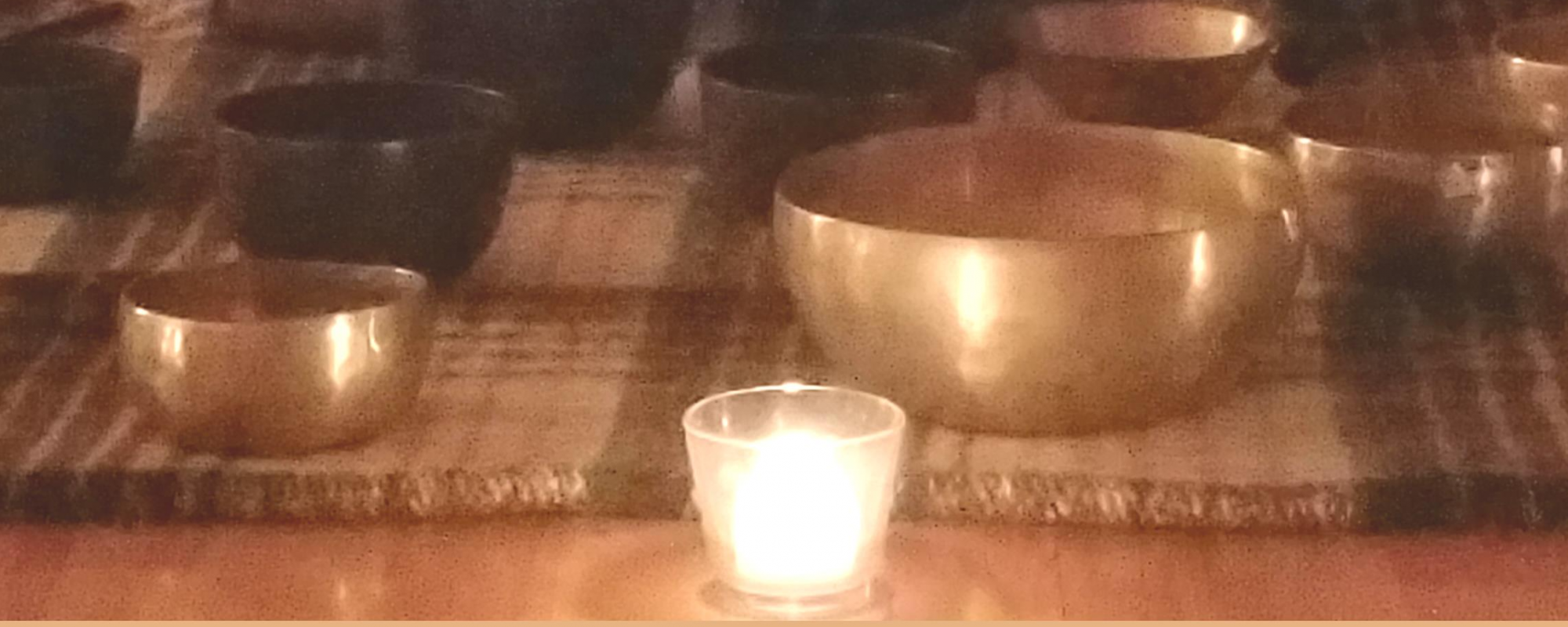
Singing bowls allow us to concentrate on pure sound energy.  We hear the tone and all the harmonizing tones that the bowl makes when struck.   The sound of the bowl gives the ear a focal point, a drishti for the ear to help remain in the present moment.  Striking the bowl harder or softer makes a difference in the sounds that emerge from the bowl.

Singing bowls are used in music, meditation and some religious practices.  Many notes can be heard depending on how the bowl is played.  A mallet is used to strike the bowl, causing it to vibrate.  When struck with a mallet, singing bowls produce harmonious sounds, which brings a sense of deep relaxation.

This bowl has two notes blending at once.  See if you can pick out each of them, and listen to how they interact with each other.

Bowls can also be “sung” using a circular motion around the lip of the bowl.  This causes the bowl to resonate and ring out.  Different bowls will have different sounds.  Some have the ability to generate various sounds depending on how they are struck. Generally smaller bowls have higher tones, while larger bowls have lower ones.  The types of metals used to make a bowl vary but may include brass,copper, and tin.  Sometimes small amounts of iron, lead, gold, silver and even mercury are added in the belief that this will create a better sounding bowl.  Bowls can be old or new, hand hammered or machine made.  For purposes of meditation, the age of the bowl does not matter.  It is the sound quality of the bowl that counts.

To really hear the bowl we must listen to the ‘non-sound’ that is made between the sounds of the bowl being struck.  This empty space between the sounds allows us to make sense of the soundscape and is equally a part of the listening experience.

Play these sound files in the blog entry  a few times.  Try to focus on listening to the sound of the bowl.  Keep listening as the sound ends and silence returns.

Interested in hearing more? Are you near the Connecticut New London area?  I invite you to join me at my next sound concert on October 12, 2018.  Here is an opportunity to rest in stillness and allow the power of sound healing help center you amidst the chaos of life.  Increase your focus and awareness through practices of deep relaxation.

Details are here https://www.facebook.com/events/2187659844825742/

or http://blissworksyoga.org  under workshops.

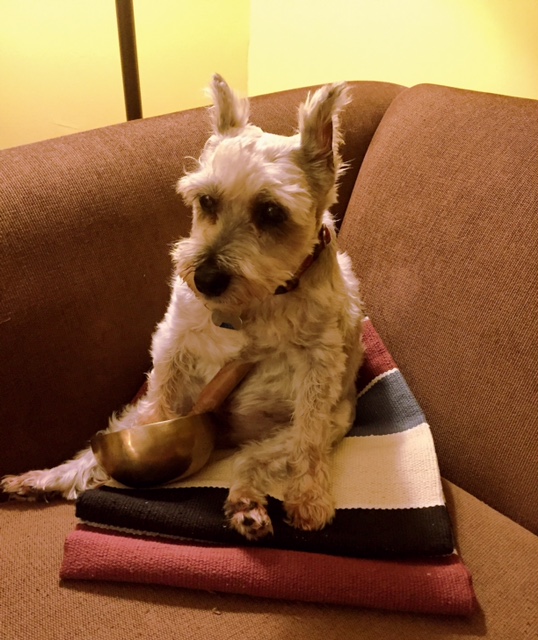
For those of us in blog space, don’t worry.  Lolly and I will be exploring the healing power of sound and singing bowls in future posts.


lollybowl


Just follow your breath

blue-sky-merge-clouds-675977


We took our first breath on the day we were born and have been breathing ever since.  Breathing is so basic to our survival yet how often are we mindful of our breath?  Are you aware of your breath as you read this post?  Lets bring some focused attention to our breath.

Take a comfortable seat.  Sit upright. Just sit with your eyes closed for a few moments noticing your body and the sensations that arise.  Let the body relax.  If you can’t seem to relax, don’t worry, just keep noticing the sensations coming from inside of you.

Set your timer for five minutes. Close your eyes.  With your mind, follow the breath as it comes in to your lungs and goes back out to the world.  If you can, breathe through your nose both on the in breath and the out breath. You can focus on just the sensation of the breath  as it comes into the nose and out of the nose.  Keep your attention to the breath sensation in your nose.  Keep breathing.  Keep noticing.  If during your time you notice your mind has slipped from watching your breath to some inner thought, gently refocus your attention on the breath.  When your timer goes off notice how you feel.  Was five minutes to short? To long?  Repeat and adjust to a comfortable time.


Calming meditation – Bringing more calm to the body

breathe

The ocean has a calming effect on me.  Listening to the waves as they crash on the beach and recede back into the water relaxes my mind and brings a feeling of wellbeing.  I imagine the ocean as a breath, inhaling and coming onto the beach, then exhaling and receding back into the deep only to start again.  We can use our breath to create this calm of watching the ocean.  The secret? Just making your breath out longer than your in breath helps calm the body down.

For this experience, we will purposely extend the length of our out breath.  First we will figure out our base-breathing pattern.  Empty your lungs and take an in breath counting to yourself how long it takes for you to take a breath into the body.  Slowly count to yourself 1, 2, 3, 4, 5 —.  What is the largest number you take before you start to exhale?  Do this a couple of times and pick the number that comes out the most.  Don’t change your normal breathing pattern by trying to take in a bigger breath.  It really doesn’t matter how long your in breath is.

In our meditation below, we will add a ‘ two count’ to our outbreath.  For example, if your in breath was a count of five,  make your outbreath a count of seven.  Making the out breath longer than the in breath in this way lets the body know it is time to calm down.  You can try this exercise during our meditation or even before going to bed.

Calming Meditation

Sit in a comfortable position. You can sit cross-legged, on on your calves in hero pose, or in a chair – it really doesn’t matter.  What does matter is that you can sit comfortably for five minutes.  Sit upright. If you are using a chair, try keeping the back straight and away from the chair.  Try sitting more toward the front of your seat.  Adjust yourself now so you can remain seated in a comfortable position without moving.  Sit for a few moments.  Let the body relax.  If you notice any holding of tension in your back or legs try to let it go.  If you feel a part of your body tense, imagine your breath coming and going through that part of the body.  For example if your thighs are tense, imagine as you breath in that your breath is flowing in and out of your thighs.  Do this visualization for a few moments.

Now, set your timer for five minutes. Close your eyes.  In your mind watch the breath as it comes in and goes back out to the world.  If you can, breath through your nose both on the in breath and the out breath.  Begin counting to yourself as before –  in our example breathing in for a count of five, and out for a count of seven.  Keep breathing this way for the full five minutes. If the count ever becomes too uncomfortable, shorten your count of the breath.  If it seems too easy, extend your count.    After your session notice the feeling of your body as well as your mind. You can repeat again or extend for longer periods of time.  Congratulations!  You have just done your first meditation practice!


IMG_2203